I am a robotics engineer at ASELSAN and hold an MSc in Robotics from
Middle East Technical University. I work on how learning and
dynamics-based control can work together to help robots move and
interact skillfully in the physical world, and on the software that
takes these methods from simulation to hardware. My work spans legged
locomotion, whole-body control, state estimation, and autonomous
drones; I am also interested in dexterous manipulation.
Publications
ICRA 2027 · Under review
Learning Structured Locomotion References for
Optimization-Based Whole-Body Control
Ö. T. Banuş, U. Saranlı, M. M. Ankaralı
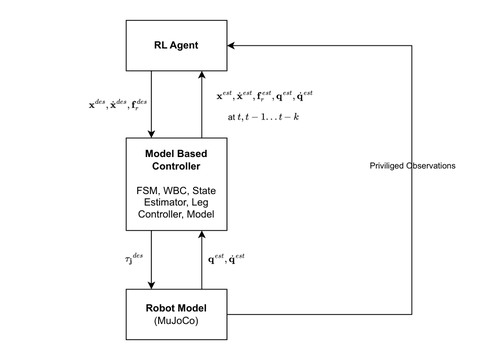
A reinforcement-learning policy adapts the references of a
whole-body impulse controller. In simulation it reached
77.29% mean survival under velocity disturbances, compared
with 50.35% for the model-based reference controller.
Learning Hierarchical Task-Space Control Policies for
Whole-Body Locomotion
Ö. T. Banuş · Advisors: M. M. Ankaralı, A. E. Turgut
A reinforcement-learning policy decides body motion, stance
forces, foothold corrections, and gait timing for a QP-based
whole-body controller. Trained in about one hour on 256
parallel environments with a custom C++/Python framework, it
recovered from larger horizontal pushes than an MPC+WBC
baseline, which remained stronger against vertical ones.
Contact Consistent Disturbance Estimation for Quadruped Robots
H. C. Özden, E. Tanfener, H. E. Orhon, Ö. T. Banuş, U.
Saranlı, M. M. Ankaralı, A. E. Turgut
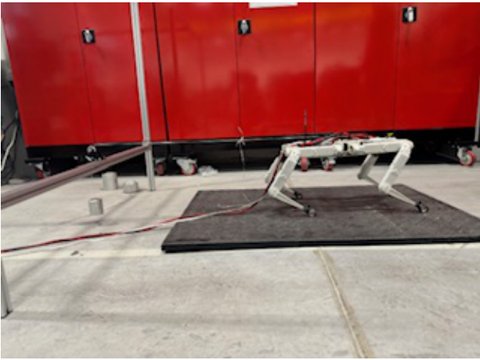
Estimates external body forces and ground reaction forces from
proprioception. Evaluated in simulation and on a Solo-12
robot, for which I ported our in-house locomotion controller.
Descriptions of employer projects are limited to what can be shared
publicly. A more detailed portfolio is available on request.
ASELSAN · 2022–2025
Blind locomotion on an in-house quadruped
Part of a small team that developed ASELSAN's in-house
quadruped from its initial concept, within the ASELSAN–METU
legged-robotics collaboration. I contributed to locomotion
control and was a key contributor to the C++ software
architecture on real-time Linux. My work included ground-plane
estimation and slope-aware MPC, stair-climbing swing
trajectories, probabilistic contact estimation from joint
torques, actuator-aware whole-body impulse control, and the
robot's MuJoCo simulation. Without vision, the robot traversed
uneven terrain, stairs, and slopes up to 45 degrees.
Deployed on three versions of the in-house quadruped, Ghost
Vision 60, Unitree Go1, Unitree Go2, and Solo-12.
ASELSAN · 2025–present
Agile autonomous drone
I own the drone's software architecture, developed from project
start, and lead GNSS-denied state estimation: a custom
error-state Kalman filter and a model-based estimator that
accounts for actuator dynamics and aerodynamic effects. I also
work on trajectory optimization and Lyapunov-based attitude
control, and built the Gazebo and Isaac Sim environments and
the software- and hardware-in-the-loop setups used to test the
stack before flight.
ASELSAN · System technical manager
Human-following quadruped on Ghost Vision 60
A quadruped that follows a person on foot. It estimates the
leader's position from UWB ranging, IMU, and magnetometer
measurements with a walking-motion model, and uses LiDAR-based
local mapping with Nav2 for routing and obstacle avoidance in
ROS 2. I led the system from requirements to field delivery
while working directly on tracking and navigation. Our team
delivered it in five months and demonstrated it at IDEF 2025.
Bilkent University · 2021–2023
Modelling a collision-resilient micro quadrotor
Flight and landing-compliance dynamics of a foldable,
collision-resilient quadrotor. Built its CAD and URDF models,
implemented cascaded PID flight control in RotorS, and wrote a
custom Gazebo plugin for the landing-gear compliance.
MSc in Robotics, Middle East Technical University (METU), Center
for Robotics and AI (ROMER)
Sep 2023 – Sep 2026
Thesis: Learning Hierarchical Task-Space Control Policies
for Whole-Body Locomotion. Advisor: Assoc. Prof. M. Mert
Ankaralı · Co-advisor: Assoc. Prof. Ali Emre Turgut ·
Collaborator: Prof. Uluç Saranlı.
Designed a hierarchical quadruped controller in which a
reinforcement-learning policy makes decisions about body
motion, stance forces, foothold corrections, and gait timing,
while a QP-based whole-body controller computes
contact-feasible joint torques.
Built a custom training framework with a Python Gym interface
for Stable-Baselines3, EnvPool-based parallelization, and a
modular C++ control backend embedded in a custom MuJoCo
environment; trained the thesis policy in about one hour on
256 parallel environments.
Designed the framework to support simulation and hardware
deployment, with interchangeable controllers, robot models,
and estimators, and a multi-module control architecture with
finite-state-machine coordination.
Implemented Cheetah Software's model-based locomotion
controller and a joint-level reinforcement-learning baseline
based on Rudin et al. within the same framework for
comparison.
Evaluated simulated push recovery against an MPC+WBC
baseline, identifying improved horizontal recovery but weaker
vertical recovery; investigated individual policy
contributions through action-channel ablations in a
first-author ICRA 2027 submission.
BSc in Mechanical Engineering, Bilkent University
Sep 2017 – Jun 2023
Full scholarship with monthly stipend; honor certificates; four
graduate-level electives in control and robotics.
Experience
Specialist Robotic Systems and Control Engineer, ASELSAN
Dec 2022 – present
Legged robotic platform Dec 2022 – Oct 2025
Worked within the ASELSAN–METU legged-robotics
collaboration, through which I conducted my MSc research at
METU's Center for Robotics and Artificial Intelligence
(ROMER).
Developed an in-house quadruped from initial concept as part
of a small team; contributed to locomotion control and was a
key contributor to the C++ software architecture on real-time
Linux.
Developed ground-plane estimation, modified convex MPC to
account for terrain inclination, and designed foot-swing
trajectories for stair climbing; the robot traversed uneven
terrain, stairs, and slopes up to 45 degrees without vision on
hardware.
Used spatial equations of motion to develop probabilistic
contact estimation from torque-derived ground-reaction
forces; triggered MPC updates when foot-contact states
changed.
Applied spatial dynamics in whole-body impulse control
(WBIC); measured actuator torque limits and incorporated
actuator-aware constraints into the QP-based controller to
limit knee-torque spikes.
Built the robot's MuJoCo simulation and CAD-to-MJCF
conversion pipeline.
Deployed and tested locomotion controllers on physical
quadrupeds; diagnosed failures through logs and hardware
experiments and investigated differences between simulation
and physical behavior.
Helped develop and implement the estimator for our IEEE CASE
2024 paper and deployed the in-house controller on Solo-12
for physical experiments.
Served as system technical manager from requirements to field
delivery; coordinated partner departments and customer
discussions while contributing directly to tracking and
navigation. Our team delivered the system in five months and
demonstrated it at IDEF 2025.
Developed leader-position estimation using UWB ranging, IMU,
and magnetometer measurements with a walking-motion model;
built LiDAR-based local mapping and integrated Nav2 routing
and obstacle avoidance in ROS 2.
Agile autonomous drone Oct 2025 – present
Own the drone's software architecture, developed from project
start; built the ROS 2 architecture and system state machine;
coordinate the deployment environment with other teams.
Lead GNSS-denied state estimation using a custom error-state
Kalman filter; develop a model-based estimator accounting for
actuator dynamics and aerodynamic effects, and work on
trajectory optimization and Lyapunov-based attitude control.
Serve on the product's systems engineering team, coordinating
work across teams and making system-level technical
decisions; integrate and validate algorithms on prototypes
through hardware and flight tests.
Developed Gazebo simulations and photorealistic Isaac Sim
environments; built simulation-in-the-loop and
hardware-in-the-loop test setups, Docker images, and
deployment tools so colleagues can run and test the software.
Undergraduate Research Assistant, Bilkent Miniature Robotics
Laboratory Oct 2021 – Jun 2023
Modeled the flight and landing-compliance dynamics of a
foldable, collision-resilient quadrotor.
Built CAD and URDF models, implemented cascaded PID flight
control in RotorS, and developed a custom Gazebo plugin to
simulate landing-gear compliance using C++ and Python.
MuJoCo, Isaac Sim, Gazebo, RotorS, software-in-the-loop and
hardware-in-the-loop testing
Honors, training, and activities
Team member, ASELSAN–METU/ROMER legged robotics collaboration,
which received the 2025 YÖK University–Industry Collaboration
Award.
Top 0.01% nationally in Türkiye's 2017 university entrance
examination (rank 157 of about 2.5 million candidates).
Top 0.13% in quantitative and equally weighted scores of ALES,
Türkiye's national graduate-admissions examination, 2023.
Participant, 10th International Summer School on
Screw-Theory-Based Methods in Robotics, 2024: screw-theory-based
methods for robot modelling; spatial dynamics for robot dynamics
and control.
Volunteer building supervisor, Oy ve Ötesi (election-monitoring
organization), 2018–2023.
Languages
Turkish (native) · English (TOEFL iBT 110/120, 2026; IELTS Academic
8.0, 2022) · German (elementary)